How to price a website when you outsource development
Cost your agency’s design, management and testing alongside the developer’s quote. A worked pricing example, margin calculator and payment checks.
A developer quotes £4,000. Your agency adds 30% and sends the client a price of £5,200. That leaves £1,200 for everything your team still has to do, including design, client meetings and checking the finished site.
Before you set the client price, cost that work too. Then allow for uncertainty and check what the proposed price leaves your agency.
This guide follows one hypothetical website project. All amounts exclude VAT, and the rates and percentages are example inputs. They are not Kyln prices or recommended agency margins.
Start with the work your agency still owns
Read the developer’s scope before putting their fee into your estimate. A £4,000 quote that excludes content entry leaves that work with someone else. If your agency will do it, allow for the time.
List your own delivery tasks and estimate the hours using an internal cost rate. That rate should reflect what it costs your business to provide the time, including employment costs where applicable. Using your client billing rate here can build margin into the model twice.
Count founder time as well. Being able to do the work yourself does not make the hours available for another project.
Keep track of what your internal rate includes. If it already allocates overhead, avoid adding that overhead again. If it only covers labour, the amount left after project costs still needs to contribute towards running the business.
For our example, the agency supplies the designs and manages the client. The developer builds the agreed site.
| Planned cost | Basis | Amount |
|---|---|---|
| External development | Fixed quote for the agreed scope | £4,000 |
| Agency design | 20 hours at £40 internal cost | £800 |
| Project management | 15 hours at £40 internal cost | £600 |
| Agency testing and launch coordination | 10 hours at £40 internal cost | £400 |
| Project-specific purchases | Assets and services paid by the agency | £200 |
| Total planned delivery cost | £6,000 |
The agency has £2,000 of planned costs beyond the developer’s fee. At the £5,200 selling price from the opening example, this job would be £800 short of covering those delivery costs.
Make the contingency allowance explicit
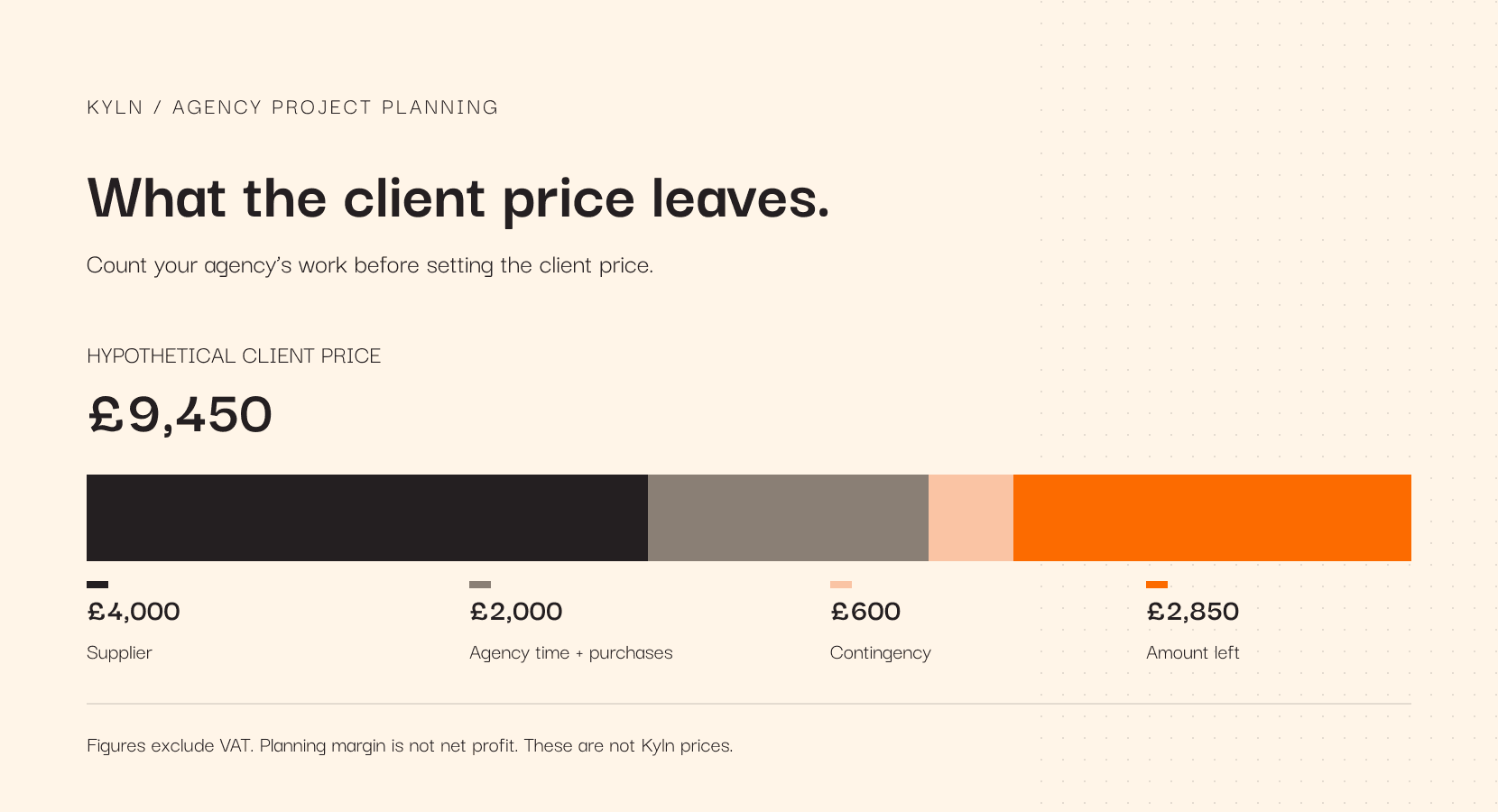
Add an allowance for uncertainty within the agreed work. In this example, 10% of the £6,000 planned cost gives a £600 contingency, taking the cost allowance used for pricing to £6,600.
The £600 has not been spent. Keep it separate from the estimated tasks so you can see how much room you have if those tasks take longer.
Choose the allowance from the risks in the project and what you know about similar work. A percentage copied from another quote will not tell you whether the content migration has been checked.
Known extra work needs its own estimate. If nobody has established whether a booking system can support the required connection, investigate it or agree an exclusion before committing to a fixed client price. Adding contingency does not resolve the technical question.
Use margin and markup consistently
Markup expresses the amount above cost as a percentage of cost. Margin expresses it as a percentage of the selling price. Xero’s explanation of margin and markup sets out both formulas.
Using the £6,600 cost allowance:
| Pricing method | Calculation | Client price | Amount above allowance |
|---|---|---|---|
| Add 30% markup | £6,600 × 1.30 | £8,580 | £1,980 |
| Allow for 30% margin | £6,600 ÷ 0.70 | £9,428.57 | £2,828.57 |
The 30% markup gives a margin of about 23.1%. To allow for a 30% margin, use:
Client price = cost allowance ÷ (1 − target margin as a decimal)
For the rest of this example, the agency rounds the price to £9,450. That leaves £2,850 above the £6,600 allowance, or about 30.2% of the sale.
This is a planning margin against the costs included in the model. It is not the business’s net profit margin. Any overhead, selling costs or other expenses omitted from the estimate still need paying.
The formula gives you a price to assess. Your positioning and the value of the work to the client also matter when setting the final quote. You can use the same model to check a price you have arrived at another way.
Check the result if you spend more
At a fixed selling price of £9,450, the result changes with actual delivery cost:
| Actual delivery cost | What happened | Amount left after these costs | Percentage of sale left |
|---|---|---|---|
| £6,000 | Work finished at the original estimate | £3,450 | 36.5% |
| £6,600 | The full contingency was used | £2,850 | 30.2% |
| £7,500 | Cost exceeded the allowance by £900 | £1,950 | 20.6% |
The last row is £1,500 above the original £6,000 estimate. The £600 contingency absorbs part of that increase; the remaining £900 reduces the amount left.
Track internal hours alongside supplier invoices. An extra day of client revisions uses agency capacity even when the developer’s fee stays fixed. Record additional client revenue separately if extra work is approved and charged.
Work backwards when the client has a budget ceiling
Suppose the client can spend £8,000. Keeping the same 30% planning margin allows:
£8,000 × 0.70 = £5,600 total cost allowance
The existing plan allows £6,600, so it is £1,000 over that limit. Selling the unchanged project for £8,000 would leave £1,400 against the allowance, a planning margin of 17.5%.
You could reduce the first release, discuss a higher budget or accept the lower margin deliberately. A smaller scope might remove a custom layout or defer a feature, but get the developer to confirm the saving before offering it.
Deleting £1,000 from the worksheet while leaving the work unchanged only hides the gap. If the project does not make sense at the available budget, decline it.
Check when the money arrives
Use the same £9,450 project to check payment timing. Suppose the client’s 20% deposit has cleared on 1 November and the developer’s 50% deposit is due on 2 November.
You receive £1,890 and owe the developer £2,000. Your agency needs to fund the £110 difference, plus payroll and any other bills due before the next client payment. If the client deposit arrives late, the immediate gap is larger.
The deposits form part of the agreed prices. Do not add them to the project cost again.
Map the expected receipts and payments by date before accepting the terms. Include the later milestones, since client approval or payment delays can leave you funding the next stage too. Agree a schedule you can fund; sending an invoice does not put the money in your account.
Price support separately
If the client wants ongoing support, cost the supplier service and your agency’s involvement in handling the account. Agree which requests are included, how additional work is charged and who pays for hosting or licences.
Check that any response commitments you offer the client are supported by the service you are buying. Keep the support scope and recurring price separate from the website build.
Use the project margin calculator
Open the agency project margin calculator to change the costs, compare margin with markup and check an overrun. Figures stay in your browser. The starting figures match the hypothetical example above.
Copy this pricing worksheet
Use one cost basis throughout. Keep the scope assumptions beside the figures.
| Input | Your figure |
|---|---|
| Supplier development quote | £ |
| Agency hours × internal cost, by role | £ |
| Other project costs not already included | £ |
| A. Total planned delivery cost | £ |
| B. Contingency allowance | £ |
| C. Total cost allowance: A + B | £ |
| D. Target planning margin, as a decimal (30% = 0.30) | |
| Calculated client price: C ÷ (1 − D) | £ |
| E. Final quoted price | £ |
| Planning margin at final price: (E − C) ÷ E × 100 | % |
| Largest cumulative cash shortfall on the payment schedule | £ |
After delivery, replace the estimates with actual costs and compare them with the final project revenue. Keep notes on where the hours changed so the next quote starts from better information.
At Kyln, I quote the agreed technical work to your agency at wholesale. You keep the client relationship and set the client price. If you are costing a website project, talk through the development scope with me before committing the technical budget.
Related articles

Website development brief template for creative agencies
Brief a developer before you quote your client. A practical website brief template for creative agencies, with responsibilities and a worked CRM example.
Read article
The four readiness bands for AI-built apps
Prototype, Fragile, Hardening and Sellable: the scale Kyln uses to grade how close an AI-built product is to something you can put in front of real buyers. The method, not a sample score.
Read article